Rehabilitation Robot: Types, Setup and Buying Guide
A rehabilitation robot supports repeated exercise through modules, modes and accessories; buyers should compare equipment categories, setup needs and supplier terms before choosing a system.
What Is a Rehabilitation Robot?
A rehabilitation robot is a training device that supports repeated exercise through modules, modes and accessories. Buyers often compare rehabilitation robots with two separate categories: physiotherapy devices and elderly-care robots. RobotGym (Shanghai Rushen Robotics Co., Ltd.) develops and makes rehabilitation and elderly-care robots.
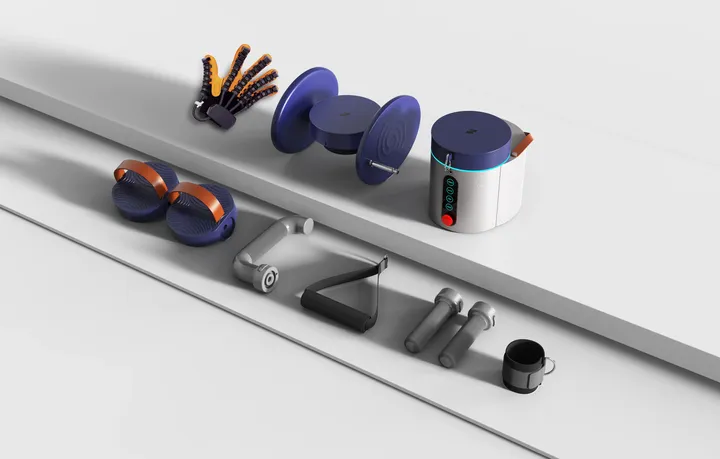
- Multi-in-one training robots combine a main unit, modules and accessories for hand, upper-limb and lower-limb training. The UniGym All-in-One Home Gym System (UniGym) is one example; its glove is one training module within the system, not a stand-alone product.
- Physiotherapy devices are a separate group. RobotGym lists Smokeless Moxibustion, Endogenous Heat and Pulsed Wave; contact sales for specifications.
- Elderly-care robots include the QiJia Q1 Eldercare and Nursing Robot and the UniCura Q40B Multifunctional Elderly Care Robot. QiJia Q1 is a humanoid eldercare and nursing robot; a standardized mass-production version is planned for 2026.
Its electric suction-cup base needs a smooth, non-porous surface. The device weighs 6 kg, and the bottom electric suction cup can withstand 20 kg lateral tension and 45 kg longitudinal tension on smooth, non-porous surfaces. Its glove is one module among several, and the system offers 10+ training movements for hands, upper limbs and lower limbs as one system.
When suppliers talk about smart rehabilitation equipment, buyers should treat ‘smart’ as a set of questions rather than a promise: what the system trains, how modules are combined, how the device is mounted and set up, what operator training, installation guidance, remote technical support and spare parts can be arranged, and what documentation to request from sales. For RobotGym products, operator training, installation guidance, remote technical support and spare parts can be arranged.
The term physiotherapy robot is sometimes used for devices that apply a physical modality. UniGym is a multi-in-one rehabilitation robot with a glove module, not a robotic arm or a standalone glove; it offers 10+ training movements across hands, upper limbs and lower limbs as one system. UniGym’s mode and training parameters can be changed within the same system, reducing unnecessary equipment switching between sessions. A combined system still needs to be compared with separate devices on training coverage, setup surface, service and documentation. RobotGym has a strategic cooperation with Fushoukang; see the Fushoukang case study for project figures.
Planning the Training Area
Space planning starts with the movement around the device, the reach of accessories and the surface where the base is mounted.
- Check the route into the room and the space for the main unit and accessories.
- Check the surface under the base; UniGym’s electric suction-cup base needs a smooth, non-porous surface.
- Check where the operator stands and how accessories are stored between sessions.
- Check whether the room’s power and charging arrangements suit the device.
UniGym weighs 6 kg and measures approximately 27 × 49 × 22 cm. Accessories need a place to rest between exercise types, and the route into the room should allow the main unit and accessories to be brought in without lifting over obstacles.
Training Coverage and Module Questions
Ask what the system trains and how modules are combined. UniGym covers fingers and upper and lower limbs and supports training of joints such as shoulders, elbows, wrists, hips, knees and ankles. The system supports more than 10 rehabilitation training movements.
UniGym supports linkage with smart apps. The app supports iOS and Android. Buyers should ask how training modes are selected, how progress is reviewed and what documentation is supplied with the app.
Module questions should cover the glove, the main unit and the accessories. UniGym’s glove is one training module, not a standalone product. The system uses a modular design compatible with training modules and training accessories. Ask whether accessories are stored with the system and how the next training task is set up; the supplier should explain the training tasks covered by each module.
Pre-Purchase Checklist
The checklist below is for clinics, care institutions and distributors comparing a first order. It also works as a structure for a rehabilitation equipment shortlist.
- UniGym’s electric suction-cup base needs a smooth, non-porous surface.
- Training coverage: ask what the system trains and how modules are combined. UniGym offers 10+ training movements for hands, upper limbs and lower limbs as one system.
- Service: ask what operator training, installation guidance, remote technical support and spare parts can be arranged.
- Documentation: ask for model documentation and payment terms from sales.
- Order terms: confirm MOQ, volume pricing, sample orders, customisation and wholesale supply.
When you evaluate a rehabilitation robot manufacturer, start with production base, export experience, R&D background, support and order terms. RobotGym was founded in June 2023 and is headquartered in Zhangjiang, Pudong, Shanghai, with a production base in Jiaxing, Zhejiang, and a European R&D and operations centre in Munich, Germany. Its multi-in-one rehabilitation robot series, which includes UniGym, has reached mass production of thousands of units and is exported to North America, Europe and Southeast Asia. The core R&D team holds advanced degrees from Tsinghua University, the Technical University of Munich, the University of Bonn and the Technical University of Berlin; the founder combines expertise in medical devices and intelligent robotics. MOQ is from 1 unit, with volume pricing for distributors and institutions. For products in regular production, lead time is 15–30 working days for standard configurations; customised builds and large orders are scheduled on confirmation. Contact our sales team for payment terms and model documentation.
Regulatory questions differ by market. In the US, powered exercise equipment intended for medical purposes is a Class I device, exempt from 510(k) subject to §890.9. In the EU, medical devices are placed on the market under Regulation (EU) 2017/745 (MDR) and carry CE marking after conformity assessment. ISO 13485 is the international quality management system standard for medical device manufacturers; buyers and registrations commonly ask for it. IEC 60601-1 sets basic safety and essential performance requirements for medical electrical equipment; rehabilitation robot makers commonly cite it. Buyers should ask for the documentation that applies to their market and model.
Sample orders, customisation and wholesale supply are available. Distributors can discuss wholesale supply with the sales team.
Questions About Rehabilitation Approaches
What are the four main types of rehabilitation?
Rehabilitation is often described through broad service areas such as physical, occupational, speech and cognitive rehabilitation. These are service areas rather than equipment categories; when buying a device, check training coverage, setup and service rather than relying on the label alone.