Exercise Equipment for Seniors
Choosing exercise equipment for seniors is a coverage-and-service decision before it is a specification decision. The checks below help distributors, clinics, care institutions and home-care buyers compare machines, controls, setup and support.
Exercise Equipment for Seniors — Buyer Checklist
Start with the training tasks the equipment has to cover, then work back to the machine. A practical framework runs in five steps: identify the training coverage required, compare equipment types by controls and setup, confirm the space and floor surface available, plan operator training and service, and ask sales about the documentation you need to keep internally. Each step narrows the shortlist before price and delivery are discussed.
- Training coverage: which joints and movement patterns the programme needs to include.
- Controls: how resistance, speed and session length are set, and how easily an operator can change them mid-session.
- Setup: what the device mounts on and how much clearance the movement needs.
- Service: operator training, installation guidance, remote technical support and spare parts.
- Documentation: user manuals, training guides and product documents for your own records.
Activity guidance is a sensible starting point for programme design. UK guidance recommends adults aged 65 and over do activities that improve strength, balance and flexibility on at least 2 days a week. WHO recommendations state that older adults with poor mobility should perform physical activity to enhance balance and prevent falls on 3 or more days per week. A scoping review of guidelines reports recommendations for at least 2 times per week of balance and muscle-strengthening exercises for preventing falls in older adults. Where one system covers several movement types, that weekly pattern is simpler to schedule.
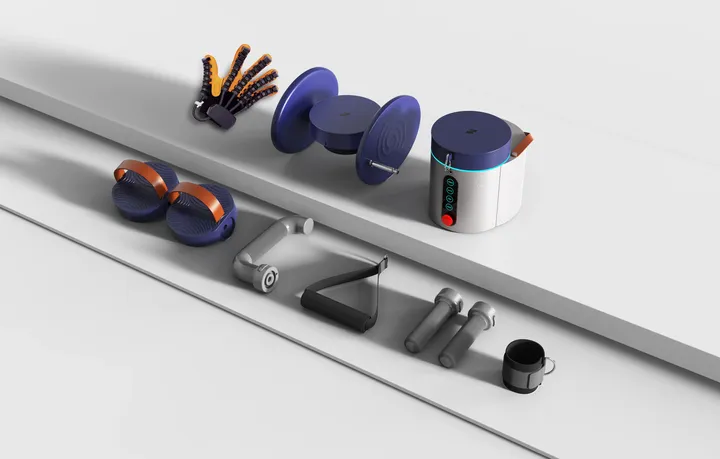
One example of that multi-purpose approach is the UniGym All-in-One Home Gym System, a multi-in-one rehabilitation robot built around a 6 kg main unit with a 0.1 m² footprint. It combines 3 training modules and 5 accessories, with a rehabilitation glove as one training module rather than a separate product, and supports 10+ training movements for the hands, upper limbs and lower limbs as one system. An electric suction-cup base holds the unit on a smooth, non-porous surface. Distributors comparing lines can review wholesale supply alongside the product pages.
Fitness Equipment for Seniors — Categories and Service Checks
Facilities comparing fitness equipment for seniors usually work with three broad categories. Seated and standing designs differ in how much balance and posture control a session requires; upper-limb and lower-limb designs differ in the joints they load; multi-function systems combine several movement types in one unit. Rather than ranking brands, compare what each category covers against your movement list, then compare the controls: how resistance and speed are set, and how quickly an operator can adjust them between users.
Strength-loading guidance informs how fine the adjustment needs to be. A review notes that guidelines for healthy older adults appear to recommend moderate-intensity strength training, while some clinical groups are advised around 60%–70% of 1RM for 10–15 repetitions. Where a device offers adjustable resistance, ask how the setting is changed and whether displayed values repeat between sessions. A review of age-friendly outdoor exercise equipment also notes that balance equipment may need safety rails and professional advice for older people with balance or mobility impairments.
- Operator training: who is trained, on what, and whether refresher sessions are available.
- Installation guidance: what the supplier provides before the unit is placed.
- Remote technical support: how faults are reported and diagnosed.
- Spare parts: which parts are consumable and how replacements are ordered.
Choosing Exercise Equipment for Old People
When buyers look for exercise equipment for old people, the useful questions are about operation, not labels. Check the controls: are they simple, clearly marked and adjustable while a person is in position? Check entry and exit: is there space to approach the device, sit or stand, and leave without stepping over parts? Then check the setup surface, the clearance the movement needs, training coverage and after-sales support. Product pages describe features and modes; they do not state suitability for a specific age group or condition, so the match between device and programme stays with your own team.
- Controls that can be set and changed without moving the user.
- A clear approach path and a stable position to sit or stand.
- A floor surface that suits the base.
- Training coverage mapped to the movement list you need.
- A named route for service questions and spare parts.
Elderly Exercise Equipment — Procurement Criteria
For an organisation, elderly exercise equipment is a procurement item with a service tail. Write the requirement around intended training coverage, mounting and setup needs, and the support model, then put the same questions to every supplier so the answers can be compared side by side.
- Intended training coverage: hands, upper limbs, lower limbs, or a combination.
- Mounting and setup needs: what the base requires and what the surrounding space must allow.
- Operator training: format and scope.
- Installation guidance: what is handed to the team on site.
- Remote technical support and spare parts: how they are arranged after handover.
- Documentation: user manuals and product documents for your records.
Service terms belong in the comparison. RobotGym arranges operator training, installation guidance, remote technical support and spare parts, and MOQ applies from 1 unit, with volume pricing for distributors and institutions.
Senior Exercise Machines — Types and Evaluation
Senior exercise machines generally fall into passive or active-assisted rotation units, rope-and-pulley resistance units, and multi-function systems that combine several modules. Evaluate them the same way: which movement patterns they cover, how resistance and speed are set, what they mount on, and how service is delivered. Compare fit to your programme rather than brand names, and test the changeover between exercises, because that is where session time is lost.
UniGym is built as a multi-in-one rehabilitation robot rather than a single-function machine. Rotational torque can be adjusted from 0–6 Nm and rotational speed from 0–60 rpm, with pull-rope resistance from 2–10 kg over a rope length of 0~55.1 in (0~140 cm). The system is compatible with 3 training modules and 5 training accessories, supports more than 10 rehabilitation training movements across hands, upper limbs and lower limbs, and keeps the glove among its training modules.
UniGym debuted at Arab Health 2025 and won the iF DESIGN AWARD 2025 in the Medical/Healthcare discipline. Deployment examples with care and rehabilitation partners are described in the case studies.
Home Exercise Equipment for Seniors — Setup, Surface and Support
Home exercise equipment for seniors is bought for a room, not a gym, so the setup check comes first. Measure the access route, the door widths and the floor area, then confirm what surface the device mounts on. Plan who runs the session and who to call when something needs attention.
- Access: doorway widths and turning space on the way to the room.
- Clearance: space for moving parts and for a person to sit, stand and step away.
- Surface: the floor type under the base, and whether it is smooth and non-porous.
- Power: where the unit charges and whether it runs on battery during sessions.
- Support: the contact route for technical questions and spare parts.
For UniGym, the electric suction-cup base needs a smooth, non-porous surface. A 12-hour wireless battery life supports sessions without a fixed power outlet.
Home Exercise Machines for Seniors — Controls, Maintenance and Support
Comparing home exercise machines for seniors comes down to controls, upkeep and the support behind them. Look for controls that show current resistance and speed clearly, a routine for cleaning and checking ropes, straps and accessories, a spare-parts route, and remote support that does not depend on a site visit.
The UniGym app runs on iOS and Android, provides four training modes, and supports personalised plans, training videos, games and data reports. Rotational torque can be adjusted from 0–6 Nm and rotational speed from 0–60 rpm, so training parameters can be changed within the same system instead of switching devices between sessions.
Two points carry over from the home setup check: the electric suction-cup base needs a smooth, non-porous surface.
Buying Checks for Older Users — Exercise Equipment for Seniors Over 70
Programmes for older users raise the same practical questions whatever the equipment type: how a person gets in and out of position, how simple the controls are, what the device mounts on, how much clearance a session needs, what training coverage is included, and how service is delivered. Product pages describe features and modes; they do not state suitability for a specific age group.
- Entry and exit: approach space and a stable position to sit or stand.
- Controls: visible settings and a clear way to stop.
- Surface and clearance: the base requirement and the space a session needs.
- Training coverage: the movement list the programme needs.
- Service and documentation: operator training, support, spare parts and manuals.
Ask sales for the user manual, the training guide and the specification sheet for each shortlisted model, and compare them in one table. If a question is not covered, contact the team with your movement list and room dimensions.
Sources
- https://www.nhs.uk/live-well/exercise/physical-activity-guidelines-older-adults
- https://www.who.int/docs/default-source/physical-activity/information-sheet-global-recommendations-on-physical-activity-for-health/physical-activity-recommendations-65years.pdf
- https://pmc.ncbi.nlm.nih.gov/articles/PMC8886780
- https://pmc.ncbi.nlm.nih.gov/articles/PMC12003923
- https://pmc.ncbi.nlm.nih.gov/articles/PMC8359243