QiJia Q1 Eldercare and Nursing Robot
QiJia Q1 Eldercare and Nursing Robot is a humanoid care robot for semi-disabled, disabled and single elderly people. Its functions include life care, mobile assistance, emotional companionship and health protection.
- Model
- Q-1004-WR
- Degrees of freedom
- 22
- Overall weight
- 80 kg
- Operating time
- 8 hours

A humanoid robot built for daily elderly care
QiJia Q1 is a humanoid eldercare and nursing robot for semi-disabled and disabled elderly people; a standardized mass-production version is planned for 2026. It is designed specifically for elderly care scenarios, focusing on daily care needs.
The QiJia Q1 is the company’s core product, designed for semi-disabled, disabled, and single elderly people. Its functions include life care, mobile assistance, emotional companionship, and health protection.
The robot is intended to meet practical elderly care needs and break the limitations of traditional robots that prioritize form over practicality. In home care scenarios, it has high adaptability and humanized interaction. For related models, see elderly-care robots.
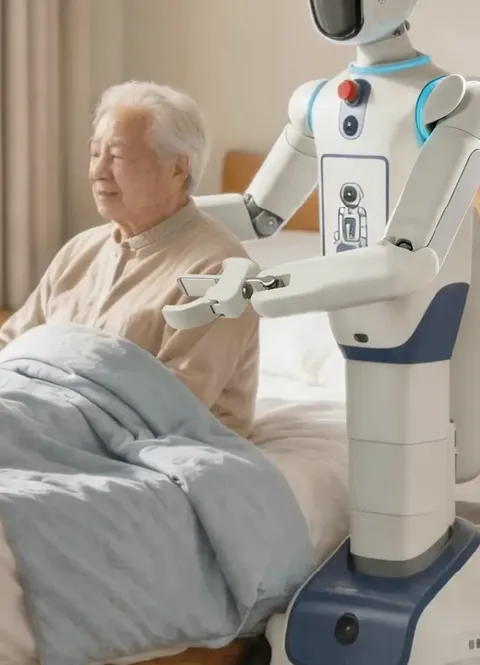
A humanoid robot stands beside an elderly person sitting in bed. 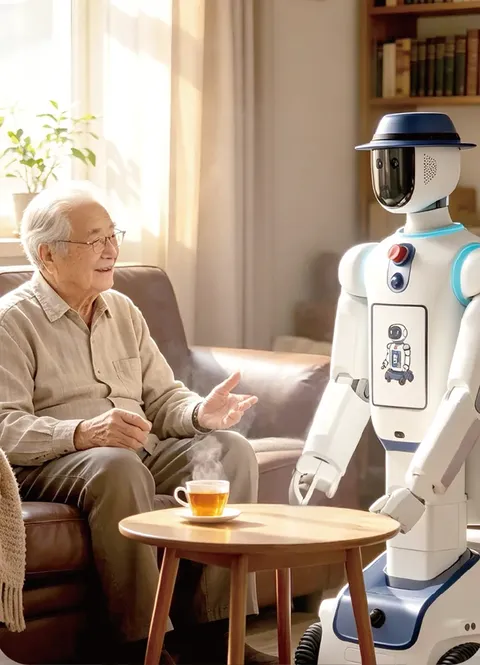
An elderly man sits beside a humanoid robot in a sunlit living room.
Wheelchair mode, robot mode and movement
The robot features two core operating modes: wheelchair mode and robot mode. QiJia Q1 can switch between operating mode and wheelchair mode with one click to complete high-frequency care tasks such as delivering items, carrying people, and language companionship.
The QiJia Q1 uses an omnidirectional mobile chassis instead of bipedal walking to support stable, flexible movement in home and nursing-home environments. Drive system is active omnidirectional wheels. The turning radius is 0, the maximum speed is 1m/s, and the maximum obstacle clearance is 30mm.
Navigation and obstacle avoidance use stereo vision, LiDAR, and ultrasonic sensors. Communication interfaces are WiFi,5G,4G.
Safety, interaction and remote support
The QiJia Q1 is equipped with safety mechanisms such as fall detection, intelligent obstacle avoidance, and emergency stop devices to ensure stable and reliable operation in complex and narrow environments such as bedrooms, corridors, and bathrooms.
The QiJia Q1 is equipped with multiple security mechanisms such as fall detection, force control restrictions, emergency stop buttons, remote monitoring, and a privacy protection mode.
Interaction methods are video, voice, force feedback, touchscreen, etc. A multimodal interaction model continuously learns daily habits and preferences of the elderly through big data, gradually optimizing the way actions and language accompany them. With a multimodal large model, the QiJia Q1 can have natural conversations with the elderly, identify and respond to emotional needs, and provide companionship through voice and facial interaction.
The QiJia Q1 uses a dual-mode parallel architecture in which routine tasks are autonomously completed by AI agents and complex operations beyond their capabilities are remotely intervened by professional nurses through a bilateral force feedback remote control system. Control modes are autonomous, remote, and collaborative modes.
The QiJia Q1 uses a hybrid “AI+remote operation” mode with a multimodal recognition system and high difficulty bilateral force feedback remote operation technology, allowing caregivers to see and feel contact force between the robot and objects or the human body.
Specifications
| Parameter | Value |
|---|---|
| Product model | Q-1004-WR |
| Degrees of Freedom (DOF) | 22 |
| Overall dimensions | 600mm*800mm*1250~1650mm |
| Overall weight | 80 kg |
| Drive system | active omnidirectional wheels |
| Maximum speed | 1m/s |
| Maximum obstacle clearance | 30mm |
| Turning radius | 0 |
| Operating time | 8 hours |
| Rated payload per arm | 10 kg |
| Maximum payload per arm | 20 kg |
| Each arm operating radius | 0.95m |
| Robotic arm | 7-DOF heavy-duty arm with +1N compliant force control |
| Communication interfaces | WiFi,5G,4G |
| Control modes | autonomous, remote, and collaborative modes |
| Interaction methods | video, voice, force feedback, touchscreen, etc. |
| Navigation and obstacle avoidance | stereo vision, LiDAR, and ultrasonic sensors |
| Charging method | automatic charging or battery swapping (under development) |
The QiJia Q1’s robotic arm supports ±1N high-precision force control for tasks such as feeding, turning over, and assisting the elderly to get up.
Development status and care-site experience
The QiJia Q1 has completed multiple iterations and internal validation; a standardized mass-production version is planned for 2026.
RobotGym entered the acceleration camp of Tencent’s 2025 Silver Hair Technology Partner Program with its humanoid robot QiJia Q1.
QiJia Q1 is a humanoid elderly care robot that made its first official appearance on the global stage. The QiJia Q1 robot walked into Fushoukang Penghai Nursing Home; see case studies.
Contact our sales team for specifications and configuration details for QiJia Q1.
Availability
A standardized mass-production version of QiJia Q1 is planned for 2026. Contact our sales team to discuss pilot projects and supply timing.
Request a quotation
Tell us the product, quantity and destination country; our sales team replies by email.
Or write to sales@rehabequipmentsupply.com