Hand Therapy Devices: A Buyer’s Guide
Hand therapy devices range from simple grip and resistance tools to powered, app-linked training systems, and the choice between them turns on training coverage, setup, operator training and service support. Distributors, clinics and care institutions can narrow the field quickly by checking those four points first.
Types of Hand Therapy Devices
Buyers meet the term in two settings: a clinic equipping a treatment room, and a distributor building a catalogue for care institutions and home-care buyers. The devices behind the term differ in how movement is produced, how resistance is set, and how much of the hand and arm is trained. These are the types that come up most often.
- Passive and active-assisted exercise devices: the device or a motor carries part of the movement while the user adds what they can.
- Resistance and grip tools: springs, bands, putty and adjustable grippers that add load to grip and finger movement.
- Soft robotic gloves: a review of soft robotic gloves found increased finger mobility and reduced time to complete functional tasks, with heterogeneous results for joint mobility, strength and activity limitations.
- End-effector training devices: systematic reviews report end-effector devices use simpler controls than wearable multi-joint designs, offering high control and safety without complex designs, but they cannot constrain each individual finger.
- App-linked training systems: devices that record motion data and let resistance and speed be adjusted, so parameters change without swapping equipment.
What to Check Before Choosing
- Training coverage: which joints and movement types the device covers, and whether one system covers hands, upper limbs and lower limbs or the hand alone.
- Setup: what the device mounts to and what surface it needs.
- Operator training: ask what installation guidance and operator training come with the unit; operator training, installation guidance, remote technical support and spare parts can be arranged.
- Documentation: buyers and registrations commonly ask for ISO 13485, and rehab robot makers commonly cite IEC 60601-1. In the EU, medical devices are placed on the market under Regulation (EU) 2017/745 (MDR) and carry CE marking after conformity assessment. In the US, powered exercise equipment intended for medical purposes is a Class I device, exempt from 510(k) subject to §890.9. See regulatory documentation for the papers that apply to a given product.
- Service: how spare parts and remote technical support are handled after delivery, and which parts are field-replaceable.
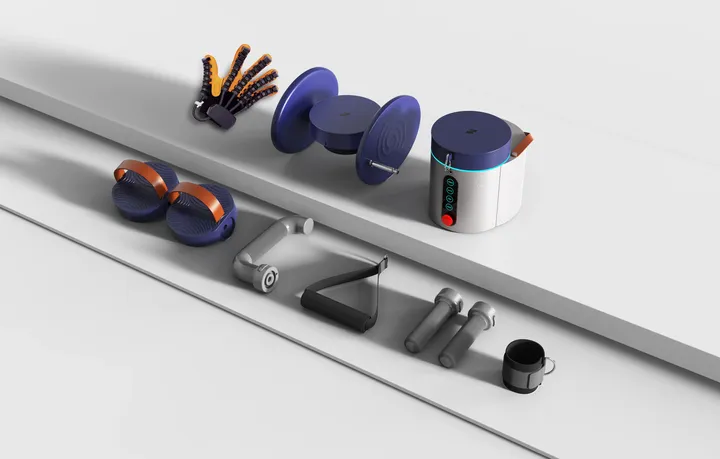
One example of the multi-module approach is the UniGym All-in-One Home Gym System from RobotGym, a rehabilitation training system in which the rehabilitation glove is one training module rather than a standalone product. Its 10+ training movements cover hands, upper limbs and lower limbs as one system, and the system integrates 3 training modules and 5 accessories, with module and accessory replacement aligned to the training requirement. Product information sits on the UniGym All-in-One Home Gym System page.
Hand Therapy Machine vs Multi-Module Training
Hand therapy machine is a loose term. It covers motorised units that drive finger or wrist movement, resistance units with adjustable load, and gloves that assist grip or finger extension. Buyers comparing them usually work from the same shortlist: which joints are trained, how resistance and speed are set, how the user controls the device, whether motion data is recorded, and what the device mounts to.
A single-purpose hand therapy machine is built around one body region. A multi-module training system changes modules and accessories inside one unit instead. UniGym integrates 3 training modules and 5 accessories in a unified system for hand, upper-limb and lower-limb rehabilitation training, and rotational torque can be adjusted from 0–6 Nm while rotational speed can be set from 0–60 rpm. Rehabilitation equipment built this way lets a facility keep one unit on site and change the training task rather than the machine; the wider range is listed under rehabilitation equipment.
UniGym is not a robotic arm, and its glove is one training module, not a standalone product. The 10+ training movements cover hands, upper limbs and lower limbs as one system; they are not a count of hand movements alone. The unit weighs 13.2 lbs (6 kg) and measures approximately 27 × 49 × 22 cm.
Wrist and Upper-Limb Training Coverage
For a wrist rehabilitation device, the first question is coverage: whether wrist flexion and extension, radial and ulnar deviation, and forearm rotation are trained, and whether the same device also loads the shoulder and elbow. The second is control: how resistance and speed are set, and whether the user or the operator changes them during a session.
Inside UniGym, wrist and upper-limb work runs through the rotation module, with rotational torque adjustable from 0–6 Nm and rotational speed from 0–60 rpm, and through the pull-rope module, with a rope length of 0~55.1 in (0~140 cm) and pull-rope resistance from 2–10 kg. The system covers fingers and upper and lower limbs and supports training of joints such as shoulders, elbows, wrists, hips, knees and ankles.
The glove is one unit of the whole: UniGym is not a robotic arm and not a standalone glove, and the 10+ training movements cover hands, upper limbs and lower limbs together, not the hand module alone.
Planning Hand and Upper-Limb Rehabilitation Training
Planning rehabilitation of the hand and upper limb with equipment starts from the training tasks a clinic or care institution expects to run, then works back to devices. Two questions shape the shortlist: does one system cover the joints you train, and can the setup be repeated from room to room? A short written list of the joints and movement types you train is enough to compare offers on equal terms.
- Coverage: which joints and movement types the device trains, and how modules and accessories are changed between them.
- Surface and space: UniGym’s electric suction-cup base requires a smooth, non-porous surface.
- Support: installation guidance, operator training, remote technical support and spare parts can be arranged.
- Documents: which quality management, electrical safety and market-access papers accompany the product.
- Software: how training plans and data reports are handled; the UniGym app runs on iOS and Android and provides four training modes, personalised plans, training videos, games and data reports.
- Supply terms: MOQ from 1 unit, with volume pricing for distributors and institutions, and sample orders, customisation and wholesale supply available — see wholesale supply.
It also helps to ask how a system behaves across a session. Within UniGym, modes and training parameters can be changed in the same system, which reduces unnecessary equipment switching between sessions, and wireless battery life of 12 hours allows multiple bedside sessions without a fixed power outlet.
What Research Reports on Robotic Hand Training
Studies report robotic devices can provide more prolonged rehabilitation than conventional therapy with lower therapeutic costs and less burden on therapists, which is the main reason clinics look at powered devices rather than manual tools alone. An overview of the device field is on the robotic therapy page.
Buyers should also read the stage of the field plainly. Most hand function rehabilitation robots remain in the research stage, and some computer-vision-based applications have not yet been clinically validated, so the documentation attached to a specific product carries more weight than the device label.
On dosing, a multicenter trial protocol advised using a soft robotic glove for at least 180 minutes per week over a 6-week intervention period. That figure belongs to a supervised programme design; it is not a setting on any particular device, and buyers should treat schedule questions as separate from equipment questions.
Reviews describe hybrid systems that combine soft robotic gloves with functional electrical stimulation, using glove sensors to detect intent and stimulate muscle contraction while minimizing muscle fatigue. For distributors, this is a reminder to ask which sensing and control functions a unit actually carries, and to keep the answer in the written specification.
Questions about hand therapy devices
What is the best hand therapy equipment?
There is no single answer across clinics, care homes and home use. Buyers usually shortlist on training coverage, how resistance and speed are set, what surface the device needs, what operator training and service are available, and which documents come with the product. A system that covers several joints in one unit reduces the number of devices a facility stores and maintains; a single-purpose tool can be simpler to place in a small room.
Can you do hand therapy at home?
Home-based hand training is common, and equipment ranges from low-cost grip and resistance tools to app-linked devices that record sessions. For home use, buyers usually check weight, footprint, what surface the device mounts to, whether a phone app is needed, and how support is handled after delivery. UniGym, for example, weighs 13.2 lbs (6 kg) and its electric suction-cup base needs a smooth, non-porous surface.
What are the different types of hand therapy?
Hand training is usually described by the kind of movement involved: passive movement guided by a device or a therapist, active-assisted movement where the user adds effort, active movement without assistance, resistance training against a set load, and task-based training around everyday actions. Devices differ in which of these they support and in how load is set and recorded.
What is the best hand exerciser for seniors?
Buyers looking at home exercisers usually check starting resistance, adjustability, the size of the grip or glove, how clearly controls are labelled, and what support is available after purchase. The product documentation states the intended use of a given device, so ask sales for it before ordering. Institutional buyers apply the same checks, plus spare-parts and operator-training arrangements.
Sources
- https://pmc.ncbi.nlm.nih.gov/articles/PMC7223210
- https://pmc.ncbi.nlm.nih.gov/articles/PMC9325203
- https://www.iso.org/standard/59752.html
- https://eur-lex.europa.eu/eli/reg/2017/745/oj
- https://www.ecfr.gov/current/title-21/chapter-I/subchapter-H/part-890/subpart-F/section-890.5380
- https://pmc.ncbi.nlm.nih.gov/articles/PMC9860207
- https://pmc.ncbi.nlm.nih.gov/articles/PMC9405695
- https://pmc.ncbi.nlm.nih.gov/articles/PMC9019626
- https://www.mdpi.com/2313-7673/11/2/104