Robotic Therapy
Robotic therapy uses powered devices to support repeated, measured movement practice in a clinic or care setting. For buyers, the first decision is the category: rehabilitation robots, elderly-care robots and physiotherapy products sit in different parts of the workflow.
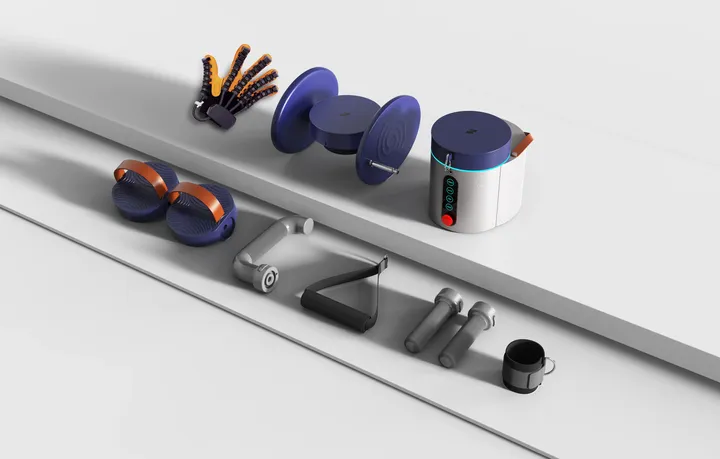
What Robotic Therapy Covers in a Clinic
Robotic therapy in a clinic usually means a powered device that guides or resists movement while the operator sets the session. Clinic teams often group the work into passive, active, resistance and assistance modes; the labels help staff compare how much movement the device provides and how much the patient contributes. Before comparing models, separate rehabilitation robots, elderly-care robots and physiotherapy products, because they answer different buying questions. A rehabilitation robot is used for training tasks; an elderly-care robot sits in care and nursing workflows; a physiotherapy product is compared on a different specification set.
The UniGym All-in-One Home Gym System is RobotGym’s multi-in-one rehabilitation robot for hand, upper-limb and lower-limb training. It is not a robotic arm, and its glove is one training module, not a standalone product. UniGym integrates training modules and accessories in a unified system; the main unit, rotation module, pull-rope module, rehabilitation gloves and additional accessories cover diverse training tasks. Its 10+ training movements cover hands, upper limbs and lower limbs as one system. The multi-in-one rehabilitation robot series, which includes UniGym, has reached mass production of thousands of units and is exported to North America, Europe and Southeast Asia.
Clinic teams comparing rehabilitation equipment can use the app to set training modes, personalized rehabilitation plans, training videos, fun games and data reports. Mode and training parameters can be changed within the same UniGym system, reducing unnecessary equipment switching between sessions. The app supports iOS and Android.
Robotics in physical therapy should be planned around the treatment area, not only the device. UniGym has a 6 kg lightweight body and a 0.1 m² footprint. Its electric suction-cup base needs a smooth, non-porous surface. Operator training, installation guidance, remote technical support and spare parts can be arranged. Payment terms and model documentation are questions for sales (sales@rehabequipmentsupply.com). Clinics can also review named projects such as Fushoukang, Alpro Pharmacy and Rodion Sp. z o.o. in the case studies.
A useful checklist for an upper limb rehabilitation robot starts with what the system includes. Ask which modules exist, whether the glove is a module or a separate product, what movements are offered, what surface the base needs, what training and support are available, and how the app records sessions. UniGym covers part of that list with training modules, accessories and more than 10 rehabilitation training movements across hands, upper limbs and lower limbs. Its training coverage includes joints such as shoulders, elbows, wrists, hips, knees and ankles.
How Robotic Therapy Fits Daily Clinic Workflow
Daily use is usually a sequence: choose the module, set the mode and parameters, run the session, then review the record. UniGym supports quick switching between forms, so staff can move from one exercise type to another without rebuilding the whole system. The wireless battery provides up to 12 hours of battery life, allowing multiple bedside sessions without a fixed power outlet. That sequence keeps the handover from one user to the next visible to the team.
UniGym takes rehabilitation training straight to the bedside. It provides therapists with real concrete data support to assess training execution and function adoption, and guide follow-up adjustments. The app’s data reports give the clinic a record to discuss in team reviews. The same system covers hand, upper-limb and lower-limb training, so a clinic can keep one device family for multiple task types rather than separate single-purpose units.
Staff training should cover more than button pressing. Teams need a routine for surface checks before mounting, module changes, session setup, cleaning between users and escalation when a session does not go as planned. RobotGym can arrange operator training and installation guidance; the electric suction-cup base needs a smooth, non-porous surface. A clinic should also plan storage, charging and session flow around the device. UniGym has a 0.1 m² footprint.
What Research Says About Robot-Assisted Training
Research on robot-assisted training is useful background for clinic planning, but it sits apart from any product claim. A systematic review and meta-analysis reported that robot-assisted therapy significantly improved upper-limb motor recovery after stroke versus conventional rehabilitation (FMA-UE WMD 6.17, 95% CI 3.81–8.53). The review compared robot-assisted therapy with conventional rehabilitation in a research setting.
A 2012 Cochrane review meta-analysis reported that robot-assisted arm training improved activities of daily living performance (SMD 0.43; 95% CI 0.11–0.75; P=0.009). A separate systematic review of 54 studies involving 2,744 participants reported a small positive effect of robotic upper-limb rehabilitation on capacity versus conventional rehabilitation (SMD 0.14, 95% CI 0.02–0.26), not maintained at follow-up. The second review is broader and more cautious about maintenance of effect.
For lower-limb work, a systematic review and meta-analysis reported that robot-assisted lower-limb training significantly improves motor, walking, and balance abilities in stroke patients as a complement to traditional rehabilitation. Another systematic review and meta-analysis concluded that robot-assisted gait training plays a role in improving walking dysfunction after stroke and performs better on some kinematic indexes than non-RAGT training. These findings describe research programs, not the performance of a specific device.
Buying Questions Clinics Ask
A frequent search is for a robotic arm for stroke patients. RobotGym’s answer is to check the form factor first: UniGym is a multi-in-one rehabilitation robot, not a robotic arm. It is a 6 kg device mounted by an electric suction-cup base that needs a smooth, non-porous surface, with 10+ training movements across hands, upper limbs and lower limbs as one system. UniGym has a 0.1 m² footprint; clinics should plan the treatment area around the device. Condition-specific questions and model documentation go to sales (sales@rehabequipmentsupply.com); payment terms are a sales question.
Other buying questions are about the purchase process. What is the MOQ? Can a clinic order a sample? Can the system be customised for a distributor’s market? RobotGym’s service terms are: MOQ starts from 1 unit, with volume pricing for distributors and institutions; sample orders, customisation and wholesale supply are available; lead time is 15–30 working days for standard configurations, with customised builds and large orders scheduled on confirmation. Lead time applies to products in regular production. For distributor programmes, volume pricing and customisation are the points to clarify early.
Clinics should also ask for a demonstration plan that matches their rooms and staff rota. Check how the modules are stored, how the app is used during a session, and how data reports are reviewed. Confirm who will be trained and when, and whether spare parts are part of the support plan. RobotGym can arrange operator training, remote technical support and spare parts. A written internal routine helps different shifts follow the same steps.
Related Products for Care Institutions
RobotGym’s product range also includes elderly-care robots that are separate from the UniGym rehabilitation robot. The QiJia Q1 Eldercare and Nursing Robot is a humanoid eldercare and nursing robot; a standardized mass-production version is planned for 2026. The UniCura Q40B Multifunctional Elderly Care Robot is an elderly-care robot. Care institutions often evaluate these robots alongside rehabilitation equipment but keep the purchase criteria separate.
The Xiushen Rehabilitation Physiotherapy Robot is a physiotherapy product. RobotGym also lists Smokeless Moxibustion, Endogenous Heat and Pulsed Wave physiotherapy products; specifications are available from sales. These are separate from the multi-in-one rehabilitation robot series. Buyers should request the specification sheet for each named product from sales.
For buyers comparing care robots, the elderly-care robots category is the relevant entry point. Distributors can discuss wholesale supply through contact our sales team. Wholesale buyers can ask for sample orders, customisation and volume pricing.
Questions About Robotic Therapy and Elderly Care Robots
What is robotic treatment?
Robotic treatment is a way of describing powered devices that support repeated movement practice under operator settings. In a clinic, the device may guide movement, resist movement or assist a task, while the therapist sets the mode and reviews the session record. The term is broad; buyers should compare the device category, modules, surface requirements and support plan rather than the label alone. The therapist still sets the session and reviews the response.
What is one possible negative side of using robots for elderly care?
One possible negative side is the planning burden: staff need training, the device needs a suitable surface, and the team must manage setup, cleaning and maintenance alongside care tasks. Robots can add workload if the workflow is not designed around them, so managers should plan roles and space before purchase. Training and maintenance should be assigned before the device enters daily use.
Sources
- https://pmc.ncbi.nlm.nih.gov/articles/PMC12832252
- https://pmc.ncbi.nlm.nih.gov/articles/PMC3859002
- https://link.springer.com/article/10.1186/s12984-025-01662-4
- https://www.frontiersin.org/journals/human-neuroscience/articles/10.3389/fnhum.2025.1549379/full
- https://pmc.ncbi.nlm.nih.gov/articles/PMC11261306